

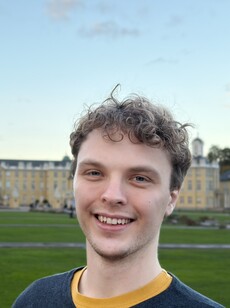
M. Sc. Johannes Marburger
- room: 404
- phone: +49 721 608-43618
- johannes marburger ∂does-not-exist.kit edu
Postanschrift: Kaiserstraße 12
Liefer- und Besucheranschrift: Gotthard-Franz-Straße 3
Geb. 50.31., 4. OG
D-76131 Karlsruhe
About Me - Johannes
I first got in touch with the food industry and sustainable food production during my Voluntary Ecological Year with BUND, where I discovered my interest in environmentally responsible food systems. During my Bioengineering studies at KIT, I pursued that interest by choosing food process engineering as my specialization and writing my bachelor’s thesis on the texturization of vegan yogurt alternatives at the Institute of Food Process Engineering (LVT). I’m also interested in biopharmaceutics, which led me to spend some time abroad at Grenoble INP and Becton Dickinson in France. That experience gave me valuable academic and hands-on insights into the field of monoclonal antibodies and biopharmaceutical formulation technology. For my master’s thesis, carried out at LVT and Loughborough University, I worked on the microfluidic production of alginate capsules for potential use in food or biotech applications.
Since October 2025, I’ve been a research associate at the LVT in the Emulsion Technology Group, where I’m working toward my PhD. Alongside my research, I’m particularly interested in fostering international collaboration and exchange (Brazil/Latin America, France, the UK, and beyond). Feel free to reach out if you’d like to connect!
Research Focus
My research centers on the controlled production of microgel particles (MGPs) made from renewable biopolymers like pectin and alginate. They can form hydrogels, which already have a wide range of applications across the life sciences, from biopharma and biotechnology to cosmetics and as functional ingredients in foods. The functionality of MGPs is closely related to how they’re made; thus, the process conditions and formulation parameters play a crucial role. My goal is to better understand and describe these relationships and then use that knowledge to design microgel particles with specific, controlled attributes (such as shape, size, chemical/physical structure) tailored for real-world applications.
Methods
To make MGPs, I use different top-down processes, including high-pressure homogenization and rotor–stator systems. I study relevant rheological properties and gelation mechanisms to fine-tune these processes. For gel and particle characterization, I use a variety of analytical techniques such as dynamic light scattering (DLS), microscopy, SAXS, and NMR. I also look at how the microgels behave over time, thus examining aspects such as gel swelling, gel aging, and the release of encapsulated compounds.
Publications list
Marburger, J.; Vladisavljevic, G. T.; van der Schaaf, U.; Leister, N.
2026, March 26. 20th Food Colloids Conference (2026), Granada, Spain, March 22–26, 2026
Marburger, J.; Vladisavljevic, G. T.; van der Schaaf, U.; Leister, N.
2026, February 27. Jahrestreffen der DECHEMA/VDI-Fachgruppe: Lebensmittelverfahrenstechnik (2026), Karlsruhe, Germany, February 25–27, 2026
Marburger, J.; Vladisavljević, G. T.; Leister, N.
2025. Colloids and Surfaces A: Physicochemical and Engineering Aspects, 714, 136541. doi:10.1016/j.colsurfa.2025.136541
Leister, N.; Vladisavljevic, G. T.; Marburger, J.
2024, September. 22nd IUFoST World Congress of Food Science and Technology (2024), Rimini, Italy, September 8–12, 2024
Saavedra Isusi, G. I.; Marburger, J.; Lohner, N.; Schaaf, U. S. van der
2023. Gels, 9 (6), Art.-Nr.: 473. doi:10.3390/gels9060473
Publications
-
High-throughput millifluidics for monodisperse alginate milli-capsules filled with emulsions https://doi.org/10.1016/j.colsurfa.2025.136541
-
Texturing of Soy Yoghurt Alternatives: Pectin Microgel Particles Serve as Inactive Fillers and Weaken the Soy Protein Gel Structure https://doi.org/10.3390/gels9060473